The floral emblem for its home state of
New South Wales,
Telopea speciosissima has featured prominently in art, architecture, and advertising, particularly since
Australian federation. Commercially grown in several countries as a cut flower, it is also cultivated in home gardens, requiring good drainage yet adequate moisture, but is vulnerable to various
fungal diseases and pests. A number of
cultivars with various shades of red, pink and even white flowers are available.
Horticulturists have also developed
hybrids with
T. oreades and
T. mongaensis which are more tolerant of cold, shade, and heavier soils.
[edit]Description

Seed pods containing several beige seeds at bottom
Telopea speciosissima, the New South Wales waratah, is a large, erect shrub up to 3 or 4 metres (10–13 ft) in height with one or more stems.
[1][2] Arising vertically or near vertically from a large woody base, or
lignotuber, the stems are little branched. In late spring, there is a spurt of new growth after flowering, with new shoots often arising from old flowerheads.
[3]The dark green leaves are
alternate and usually coarsely-toothed, ranging from 13 to 25 cm (5–10 in) in length.
[1] Enveloped in leafy
bracts, the flowerheads develop over the winter and begin to swell in early spring,
[1][4] before opening to reveal the striking
inflorescences. The exact timing varies across New South Wales, but flowering can begin as early as August in the northern parts of its range, and finish in November in the southern, more elevated areas.
[3] Spot flowering may also occur around March in autumn.
[5] Containing up to 250 individual flowers, the domed flowerheads are crimson in colour and measure 7–10 cm (3–4 in) in diameter. They are cupped in a
whorl of leafy bracts which are 5 to 7 cm (2–3 in) long and also red.
[1][3] Variations are not uncommon; some flowerheads may be more globular or cone-shaped than dome-shaped, and the bracts may be whitish or dark red. The tips of the
stigmas of some inflorescences may be whitish, contrasting with the red colour of the rest of the flowerhead.
[6] An individual flowerhead reaches full size about two weeks after first emerging from the bracts, and lasts another two weeks before the flowers fade and fall. In the first phase, the individual small flowers, known as
florets, remain unopened—and the flowerhead retains a compact shape—before they mature and split open, revealing the
stigma,
style, and
anther. The anther is
sessile, lacking a filament, and lies next to the stigma at the end of the style. The outermost florets open first, with
anthesis progressing towards the centre of the flowerhead, which becomes darker and more open in appearance, and begins attracting birds and insects. The
ovary lies at the base of the style and atop a stalk known as the
gynophore, and it is from here that the seed pods then develop. Meanwhile, a crescent-shaped
nectary lies at the base of the gynophore.
[5][7]The seed pods grow to 8–15 cm (3–6 in) long.
[8] The pods eventually turn brown and leathery, usually in early winter,
[5] splitting open to reveal the winged seeds inside.
[1] In the wild, only two or three seed pods develop per flowerhead, but there may be anywhere from 5 to 50 in cultivated plants.
[5][edit]Taxonomy

Hand-coloured engraving of
Telopea speciosissima by
James Sowerby from
A Specimen of the Botany of New Holland.
Telopea speciosissima is one of five species from southeastern Australia which make up the genus
Telopea. Its closest relative is the very similar Gibraltar Range waratah (
T. aspera) from northern New South Wales, which was only recognised as a separate species in 1995, having previously been considered an unusual northern population of
T. speciosissima.
[12] Although no subspecies are recognised within
Telopea speciosissima itself, geographical variations within its range have been noted. Forms toward the northern limits of its range have more prominently lobed leaves.
[12] A population from
Waterfall has darker red, wider inflorescences,
[16] and a population at West Head in
Ku-ring-gai Chase National Park has paler inflorescences.
[16] Leaf shape varies widely.
[16]The
common name waratah was first applied to this species before being generalised to other members of the genus
Telopea and, to a lesser extent,
Alloxylon.
Waratah is derived from the
Eora Aboriginal people, the original inhabitants of the
Sydney area.
[11] The
Dharawal people of the Illawarra region knew it as
mooloone,
[17] and
mewah is another aboriginal name. A former common name from around 1900 is "native tulip", possibly derived from
Telopea.
[11][edit]Distribution and habitat

Distribution of
Telopea speciosissima(highlighted in red) within Australia
The species is found in
New South Wales (Australia) from the
Watagan Mountains southward to
Ulladulla, with a relatively widespread distribution in the
Central Coast region.
[2] It usually occurs as an
understory shrub in open forest on sandy soils in areas with moderately high rainfall,
[1]receiving on average around 1200 mm (50 in) a year.
[18] Dappled shade from
eucalyptus (Eucalyptus) trees reduces sunlight by around 30%.
[3] Much of its range occurs in the
Sydney Basin, an area with one of the highest human populations and most intense development in Australia. The impact of
habitat fragmentation and decreased fire interval (time between
bushfires) on the gene pool of
Telopea speciosissima, which relies on
outcrossing, is unclear. Although largely protected within National Parks and conservation reserves in the Sydney area, most populations are small, numbering under 200 plants, and are often located near urban developments.
[16][edit]Ecology
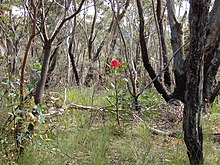
Waratah in flower in bushland, regenerating from fire in recent years, dominant above slower-growing understory plants
Telopea speciosissima is a
pyrogenic-flowering species, relying on post-fire flowering followed by production and dispersal of non-dormant seeds to take advantage of favourable growing conditions in the altered environment following a fire. Of the woody
resprouter species of southeastern Australia, it is one of the slowest to produce seedlings after bushfires, taking at least two years.
[19] The species resprouts from a
lignotuber, a swollen woody base largely under the soil, that stores energy and nutrients as a resource for rapid growth of new shoots after a bushfire. Waratahs dominate the understorey around two years after a fire, but are later overtaken by the slower-growing
banksias (Banksia) and
wattles (Acacia). Fire also serves to strip away diseases and pests.
[20] Flowering may be prolific at this time.
[21] 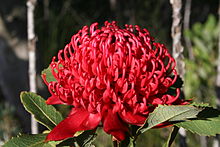
Fully mature flowerheads with opened florets, like this specimen from the
Royal National Park, attract many animals.
The New South Wales waratah had been considered to be
protandrous (that is, with male parts concluding sexual activity before female parts become receptive on the same plant),
[7] but analysis of the timing of pollen viability and stigma receptivity has shown significant overlaps.
[24]The species has been shown to be self-incompatible, requiring
cross-pollination with plants of other
genotypes to reproduce successfully.
[25][edit]Cultivation

In cultivation,
Telopea speciosissima on left next to larger more vigorous
T. 'Shady Lady' at right
The New South Wales waratah was a popular garden plant at the beginning of the 20th century. It had been introduced early (1789) into the United Kingdom, and was reported flowering for the first time in 1809 at Springwell, the villa of one E. J. A. Woodford Esq. The
Royal Horticultural Societyawarded it an
Award of Merit in 1914, and a First Class Certificate in 1922.
[11]Initially, waratahs were picked from the bushland for market, but by the early 20th century, a few
plantsmen grew concerned at the development of urban areas at the expense of bush, particularly areas noted for wildflowers. Percy Parry of Floralands in
Kariong developed the idea of "Preservation by Cultivation" and investigated the commercial cultivation of waratahs and other native plants. Meanwhile, the New South Wales Government was looking to curb flower and plant collecting from the wild, and considered prohibition in 1944, but after witnessing the ability of Parry to manage and develop cultivation, introduced compulsory licences for wildflower collecting the following year. With his wife Olive, Percy promoted and developed knowledge over fifty years and received the
Order of Australia medal in 1981.
[26] Following on from the Parrys were Howard Gay and Arch Dennis, who pioneered growing waratahs at Monbulk in the
Dandenong Ranges in the 1940s, Sid Cadwell and Frank Stone, who did likewise in
Dural and the Blue Mountains respectively.
[27] The growing movement for cultivating and preserving native plants led to the establishment of the
Society for Growing Australian Plants in 1957,
[27] and the waratah was featured heavily in the first edition of its journal
Australian Plants.
[28]Today, New South Wales waratahs are grown commercially in Australia north of Sydney and in the
Dandenong Ranges near
Melbourne. They are also grown commercially in
New Zealand and in
Israel,
[1] and also in
Hawaii, where they have been grown since 1961.
[29] One major challenge in commercial production is that in any one location the flowering season is generally short (five weeks total, with only small numbers in the earliest and latest weeks). The season for cut flowers may be extended, however, by growing plants at different latitudes. The
vase life of a cut waratah is 10 to 14 days, and cut flower waratahs can be revived somewhat by water.
[6]Although they grow naturally on deep sandy soils, the species has proved adaptable to other deep, well-drained soils, especially where natural slopes assist drainage. Despite their natural occurrence in woodland, waratahs flower best in full sun, although they tolerate the dappled shade of eucalypts.
[11] Heavy pruning after flowering reinvigorates the plants and promotes more profuse flowering in the next season.
[1] Waratah blooms are highly susceptible to damage from wind, and benefit from some protection from
prevailing winds.
[30] Waratah blooms attract birds to the garden.
[11] The species is readily
propagated from fresh
seed, but cultivars must be reproduced from cuttings to remain true-to-type.
[31][edit]Cultivars
A number of natural variants of Telopea speciosissima have been selected for cultivation as follows:
- Telopea 'Brimstone Blush' is a shrub of smaller size than the species, reaching a metre (3 ft) tall, and was originally found growing on a property of Ben Richards in Oakdale, southwest of Sydney. Flowering takes place in October. The flowerhead is globular with a pink crown and has 160 individual flowers, the styles of which are pink and white towards the ends. Three rows of whorled dark red bracts surround the flowerheads.[36]
- Telopea 'Cardinal' is a form originally found on the property of Lucille Pope in Werombi, from where it was propagated and made available commercially. The original plant was a vigorous specimen reaching 3 m by 3 m (10 ft by 10 ft) and producing 100 to 120 flowerheads each year. It is named for its large dome-shaped cardinal red flowerheads, which bear 210 individual flowers and are surrounded by two rows of dark red bracts. These blooms have long vase life.[37]
- Telopea 'Corroboree', a form with longer styles, has compact inflorescences measuring 12 cm (5 in) high and wide, and is a vigorous grower. It was selected for commercial propagation in 1974 by Nanette Cuming of Bittern, Victoria, and registered with the Australian Cultivar Registration Authority in 1989. It is grown principally for the cut flower industry.[38]
- Telopea 'Fire and Brimstone' is a vigorous form with large inflorescences selected by waratah grower and author Paul Nixon of Camden, New South Wales. It is a shrub which may reach 3–4 m tall and 2 m wide, with large leaves with more heavily toothed margins.[39] Each flowerhead is cone-shaped and has up to 240 florets. The stigmas are a light red and tipped with white. The bracts surrounding the flowerheads are relatively small, while the leaves are large and can reach 44 cm (18 in) in length.[40] The cultivar is thought to betetraploid.[39] With a long vase life of 17 days, the cultivar is suitable for the cut flower industry.[40]
- Telopea 'Galaxy' has flowerheads with pinkish red tepals and white tips to the styles, surrounded by large bracts.[29]
- Telopea 'Olympic Flame' is a form with prominent bracts around the flowerheads. It has large leaves with toothed margins and flowers in early spring. Also known as 'Sunburst', it arose as a seedling in a breeding program conducted by Cathy Offord, Peter Goodwin and Paul Nixon under the auspices of the University of Sydney.[39]
- Telopea 'Parry's Dream' was a chance seedling in the early 1970s. It gave rise to this cultivar, a vigorous plant with red-pink flowerheads which reach a diameter of 10 x 10 cm (4 x 4 in) surrounded by pink bracts.[29]
- Telopea 'Shade of Pale' is an unusual pale-pink flowered form of T. speciosissima.[39] It is less vigorous than the parent plant. It was initially promoted as 'Light Shade of Pale' but there can only be three words in a registered cultivar name.
- Telopea 'Sunflare' is an early-flowering form. It has large leaves with toothed margins and flowers in early spring. It also arose as a seedling in the same breeding program by the University of Sydney mentioned above.[39] Selected in 1981, it has red flowerheads with white-tipped styles which reach 9 cm (3.6 in) in diameter.[29]
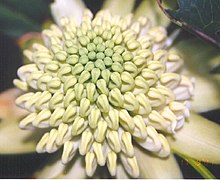
Telopea 'Wirrimbirra White'
- Telopea 'Wirrimbirra White' is a white form from Kangaloon near Robertson. Aboriginal legends of white waratahs existed, and several had been encountered, but none had been previously preserved in horticulture. Joseph Maiden had previously found a white waratah nearKurrajong,[11] and others had been sighted near Narara on the Central Coast in 1919, and Colo Vale in the 1950s. Horticulturalist Frank Stone reported one in his garden, possibly propagated from the latter plant.[41] 'Wirrimbirra White' was brought into cultivation in 1972 by cuttings from the original plant, which grew on water catchment property. It has pale greenish buds which open to a cream-white inflorescence. It is less vigorous than the parent species and vulnerable to borers.[42] It is also highly vulnerable to the Macadamia twig girdler.[29]
In addition, a number of interspecific Telopea hybrids have also been produced. These have been bred or used as more frost- or shade-tolerant plants in cooler climates such as Canberra, Melbourne or elsewhere.
- Telopea 'Braidwood Brilliant' is a frost-tolerant hybrid between a male T. speciosissima and female T. mongaensis. Dr Robert Boden of the Canberra Parks Administration began investigating this hybrid in 1962, and it was registered in 1975 by Richard Powell. It is a lignotuberous shrub to 3 m (10 ft) high and has oblanceolate leaves to 20 cm (8 in) long. The red blooms are 6–8 cm (2.4–3.2 in) in diameter, intermediate in size between the parent species.[11] It has grown well in cooler climates such as Canberra.[43]

Telopea 'Braidwood Brilliant'
- Telopea 'Canberry Coronet' is a cross between T. speciosissima from Wentworth Falls in the Blue Mountains and T. mongaensis intended for increased cold tolerance. It has red flowerheads to 6–8 cm (2.4–3.2 in) in diameter. Reaching 3–4 m (10–13 ft) high, it is a larger plant than 'Braidwood Brilliant'.[39] It was bred by Doug Verdon of the Australian National Botanic Gardens in Canberra.[36]
- Telopea 'Champagne' is a cultivar registered under Plant Breeders Rights (PBR) in 2006.[44]Its creamy yellow flowerheads appear from October to December.[29] It is a three-way hybrid between T. speciosissima, T. oreades and the yellow-flowered form of T. truncata.
- Telopea 'Golden Globe' is a cultivar registered under PBR in 2005.[45] Larger than 'Champagne', it is also a three-way hybrid between T. speciosissima, T. oreades and the yellow-flowered form of T. truncata. It has been propagated and sold as 'Shady Lady Yellow'. It was originally bred in the Dandenongs east of Melbourne.[29]
- Telopea 'Shady Lady' is a larger shrub which may reach 5 m (16 ft) high and 2 or 3 m (6–10 ft) wide. A hybrid of T. speciosissima andT. oreades, it arose by chance in a Melbourne garden. The flowerheads are smaller and lack the bracts of the speciosissima parent. As its name suggests, it tolerates more shade.[39] It is vigorous and more reliable in temperate and subtropical areas, and grows in semi-shade or sun.[29] 'Shady Lady Crimson', 'Shady Lady Red' and 'Shady Lady Pink' are three selected commercially available colour forms.[46]
- Telopea 'Shady Lady White' is a white hybrid between T. speciosissima and T. oreades.[46]
[edit]Symbolic and artistic references

The Waratah window by Alfred Handel in St Bede's Church,
Drummoyne. An early 20th century work, it depicts Australian native flowers, the red Waratah, emblem of the state of New South Wales; Flannel Flowers, Christmas Bells and Wattle (Acacia). The inscription reads "The heavens declare the glory of God. The firmament showeth his handiwork"
The New South Wales waratah featured prominently in the folklore of the
Darug and
Tharawal people in the Sydney basin and
Gandangara people to the southwest.
[47] A
Dreamtime legend from the Eora tells of a female
Wonga Pigeon searching for her husband who has been lost while out hunting. A hawk attacks and wounds her, and she hides in a waratah bush. Her husband calls and as she struggles in the bush her blood turns the white waratah blooms red.
[48] A tale from the
Burragorang Valley tells of a beautiful maiden named Krubi, who wore a red cloak of rock wallaby adorned with the feathers of the
Gang-gang Cockatoo. She fell in love with a young warrior who did not return from battle. Grief-stricken, she died, and up from the ground grew the first waratah.
[49]The Dharawal people regarded it as a totem, using it in ceremonies and timing ceremonies to its flowering.
[17]The striking form of the New South Wales waratah became a popular
motif in
Australian art in the late nineteenth and early twentieth century and was incorporated in
art nouveau designs of the time. Matchboxes, paperweights and especially tins have been decorated with the flower.
Arnott'soften used the waratah as an alternative to their parrot logo on biscuit and cake tins from the early 1900s.
[50] Shelleys soft drinks, established in 1893 in
Broken Hill, also displayed it on their label.
[50] The French artist Lucien Henry, who had settled in Sydney in 1879, was a strong proponent of a definitive Australian art style incorporating local flora, particularly the waratah.
[51]His most famous surviving work is a
triptych stained glass window of Oceania flanked by numerous waratahs overlooking the Centennial Hall in
Sydney Town Hall.
[52]In 1925, artist
Margaret Preston produced a hand-coloured
woodcut depicting waratahs.
[53] The species also appeared on an Australian 3
shilling stamp in 1959 designed by botanical illustrator Margaret Jones and a 30c stamp in 1968.
[1]After Australian federation in 1901, the upsurge in nationalism led to the search for an official national floral emblem. The New South Wales waratah was considered alongside the wattle
Acacia pycnantha, and debate raged between proponents of the two flowers. The economist and botanist
R. T. Baker proposed that the waratah's endemism to the Australian continent made it a better choice than the wattle, as well as the prominence of its flowers.
[54] He was nicknamed the "Commander in Chief of the Waratah Armed Forces".
[55] The South Australian
Evening News also supported the bid, but to no avail.
[54]Decades later, in 1962,
Telopea speciosissima was proclaimed as the official floral emblem of New South Wales by the then governor Sir
Eric Woodward, after being used informally for many years.
[56] The species has also been adopted by others, including the
New South Wales Waratahs rugby union team since the 1880s,
[50] and the former department store
Grace Bros in the 1980s.
[50] Contemporary clothing designers
Jenny Kee and
Linda Jackson produced waratah-inspired fabric designs in the 1970s and 1980s during a resurgence of Australian motifs.
[57][58]From 1956 the annual Waratah Festival was held in Sydney, run by the Sydney Committee. It took place from late October to early November, coinciding with the blooming of the waratahs. It was an important cultural event which included a parade, a popular art competition, beauty contests, exhibitions and performances.
[59] A highlight was the Lord Mayor's reception at the Sydney Town Hall for which the floral displays were made of hundreds of waratahs culled by Park Rangers from the national parks.
[edit]See also
[edit]References
- ^ a b c d e f g h i j Bowden Anne. "Floral Emblem of New South Wales". Australian National Botanic Gardens. Retrieved 27 March 2008.
- ^ a b Crisp, Michael D.; Weston, Peter H. "Telopea speciosissima (Sm.) R.Br.". New South Wales Flora Online. Retrieved 14 February 2010.
- ^ a b c d Nixon, p. 27.
- ^ Nixon, p. 23.
- ^ a b c d Nixon, p. 24.
- ^ a b Nixon, p. 25.
- ^ a b Willis, J. L. (1959). "The genus Telopea". Australian Plants (Chipping Norton, NSW: Surrey Beatty & Sons) 1 (1): 7–10.
- ^ "Telopea speciosissima". Flora of Australia online. Retrieved 16 February 2010.
- ^ a b "Embothrium speciosissimum". Australian Plant Name Index (APNI), IBIS database. Centre for Plant Biodiversity Research, Australian Government, Canberra. Retrieved 14 February 2010.
- ^ "Telopea speciosissima". Australian Plant Name Index (APNI), IBIS database. Centre for Plant Biodiversity Research, Australian Government, Canberra. Retrieved 27 March 2008.
- ^ a b c d e f g h Wrigley, John; Fagg, Murray (1991). Banksias, Waratahs and Grevilleas. Sydney: Angus & Robertson. pp. 538–41. ISBN 0-207-17277-3.
- ^ a b Crisp, Michael D.; Weston, Peter H. (1995). "Telopea". In McCarthy, Patrick (ed.). Flora of Australia: Volume 16: Eleagnaceae, Proteaceae 1. CSIRO Publishing / Australian Biological Resources Study. pp. 386–390. ISBN 0-643-05693-9.
- ^ Johnson, L. A. S.; Briggs, Barbara G. (1975). "On the Proteaceae: the evolution and classification of a southern family". Botanical Journal of the Linnean Society 70 (2): 83–182. doi:10.1111/j.1095-8339.1975.tb01644.x.
- ^ Weston, Peter H.; Barker, Nigel P. (2006). "A new suprageneric classification of the Proteaceae, with an annotated checklist of genera".Telopea 11 (3): 314–44.
- ^ a b Nixon, p. 19.
- ^ a b c d Offord, Cathy A. (2007). "Floral- and leaf-character variation in waratah (Telopea speciosissima, family Proteaceae), with reference to conservation and horticultural improvement". Australian Journal of Botany 55: 684–91. doi:10.1071/BT06211.
- ^ a b Wesson, Sue (August 2005). "Murni Dhugang Jirrar: Living in the Illawarra". Department of Environment, Climate Change, and Water, State Government of New South Wales. pp. 7. Retrieved 22 February 2010.
- ^ Nixon, p. 40.
- ^ Denham Andrew J.; Auld, Tony D. (2002). "Flowering, seed dispersal, seed predation and seedling recruitment in two pyrogenic flowering resprouters". Australian Journal of Botany 50 (5): 545–57. doi:10.1071/BT02009.
- ^ Nixon, pp. 25–26.
- ^ Parry, Percy J. (1959). "How to grow waratahs". Australian Plants (Chipping Norton, NSW: Surrey Beatty & Sons) 1 (1): 2.
- ^ a b Whelan, Robert J.; Goldingay, Ross L. (July 1989). "Pollination in Waratah". Australian Flora Foundation. Retrieved 29 March 2010.
- ^ Nixon, plate 3.
- ^ Offord, Cathy A. (2004). "An examination of the reproductive biology of Telopea speciosissima (Proteaceae) with emphasis on the role of protandry and self-pollination in fruit set.". International Journal of Plant Sciences 165 (1): 73–83.
- ^ Whelan, Robert J.; Goldingay, Ross L. (1989). "Factors affecting fruit set in Telopea speciosissima (Proteaceae): The importance of pollen limitation". Journal of Ecology 77: 1123–34.
- ^ Nixon, p. 41.
- ^ a b Nixon, p. 42.
- ^ Hockings, David (27 November 2005). "Vale – Bill Payne". Australian Native Plants Society website. Australian Native Plants Society. Archived from the original on 20 July 2008. Retrieved 28 March 2010.
- ^ a b c d e f g h Eliot Rodger W.; Jones, David L.; Blake, Trevor (2010). Encyclopaedia of Australian Plants Suitable for Cultivation: Volume 9 – Sp-Z. Port Melbourne: Lothian Press. pp. 200–03. ISBN 978-0-7344-0974-4.
- ^ Nixon, p. 58.
- ^ "Growing waratahs". Australian National Botanic Gardens. Retrieved 11 April 2010.
- ^ a b Nixon, p. 56.
- ^ a b c d Nixon, p. 57.
- ^ a b Woodford, James. "Waratah faces a fight to preserve its blooming life". The Age. Retrieved 9 March 2010.
- ^ Summerell, Brett; Steinke, Eve (1997). "Pests and Diseases of Australian Plants". Australian Plants online. Australian Native Plants Society (Australia). Archived from the original on 28 July 2008. Retrieved 28 March 2010.
- ^ a b Nixon, p. 33.
- ^ Nixon, pp. 33–34.
- ^ Australian Cultivar Registration Authority. "Telopea 'Corroboree'". ACRA: Descriptions of Registered Cultivars. Australian National Botanic Gardens. Retrieved 13 February 2010.
- ^ a b c d e f g Stewart, Angus (2001). Gardening on the Wild Side. Sydney: ABC Books. pp. 132–38. ISBN 0-7333-0791-4.
- ^ a b Nixon, p. 34.
- ^ Nixon, p. 38.
- ^ Australian Cultivar Registration Authority. "Telopea 'Wirrimbirra White'". ACRA: Descriptions of Registered Cultivars. Australian National Botanic Gardens. Retrieved 13 February 2010.
- ^ Nixon, p. 32.
- ^ "Waratah (Telopea hybrid): Variety: 'Champagne'". IP Australia: Plant Breeders Rights website. IP Australia, Commonwealth of Australia. 2006. Archived from the original on 18 July 2008. Retrieved 13 February 2010.
- ^ "Waratah (Telopea hybrid): Variety: 'Golden Globe'". IP Australia: Plant Breeders Rights website. IP Australia, Commonwealth of Australia. 2006. Retrieved 13 February 2010.[dead link]
- ^ a b "Other Varieties". Monbulk, Victoria: Proteaflora. 2010. Retrieved 7 April 2010.
- ^ Nice, p. 6.
- ^ Mudrooroo (1994). Aboriginal mythology: an A–Z spanning the history of aboriginal mythology from the earliest legends to the present day. London: HarperCollins. p. 142. ISBN 1-85538-306-3.
- ^ Nixon, pp. 15–16.
- ^ a b c d Nice, p. 54.
- ^ Nice, p. 20.
- ^ McGee, Jude, ed (2001). Visions of a Republic: The Works of Lucien Henry. Sydney, New South Wales: Powerhouse Publishing. pp. 96–97.ISBN 1-86317-078-2.
- ^ "Margaret Preston". Floral Emblems of Australia. Australian National Botanic Gardens. Retrieved 14 February 2010.
- ^ a b Nixon, p. 85.
- ^ Nice, p. 30.
- ^ Nixon, p. 86.
- ^ Nice, p. 56.
- ^ "Influence of Aboriginal and Torres Strait Islander textiles on non-indigenous Australians". Powerhouse Museum. Retrieved 30 March 2010.
- ^ The Australian, Triumph of the Artificial, 02-08-2008




.jpg)


